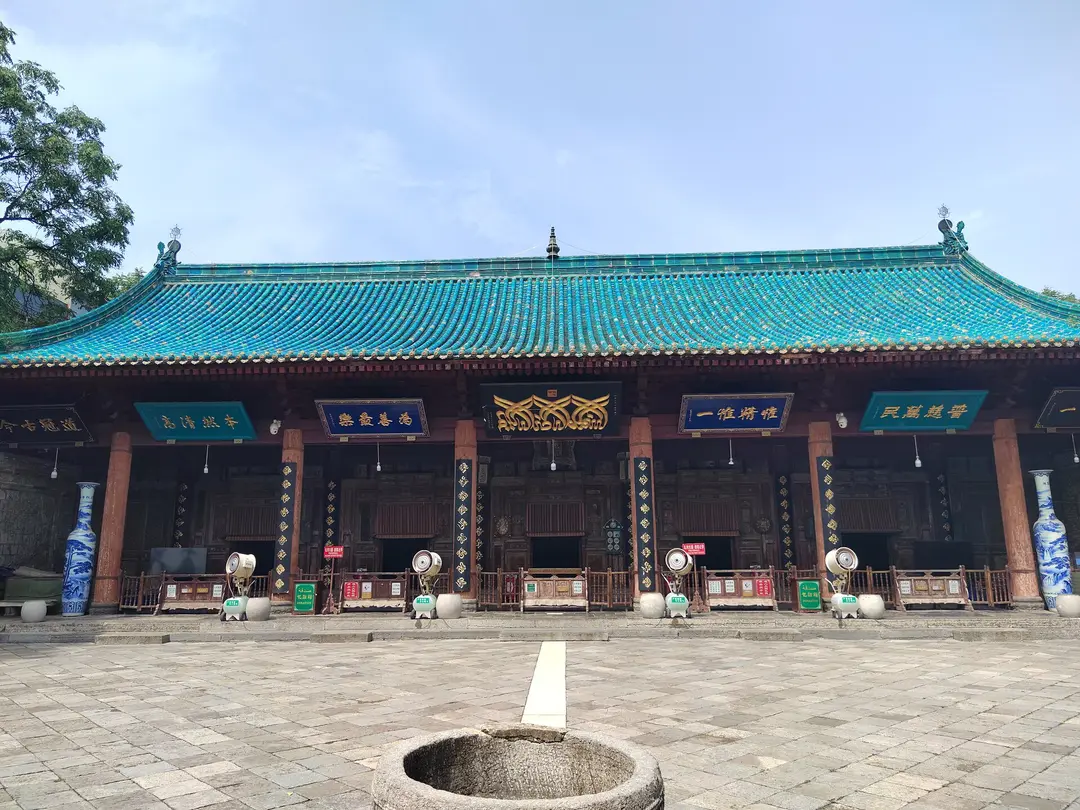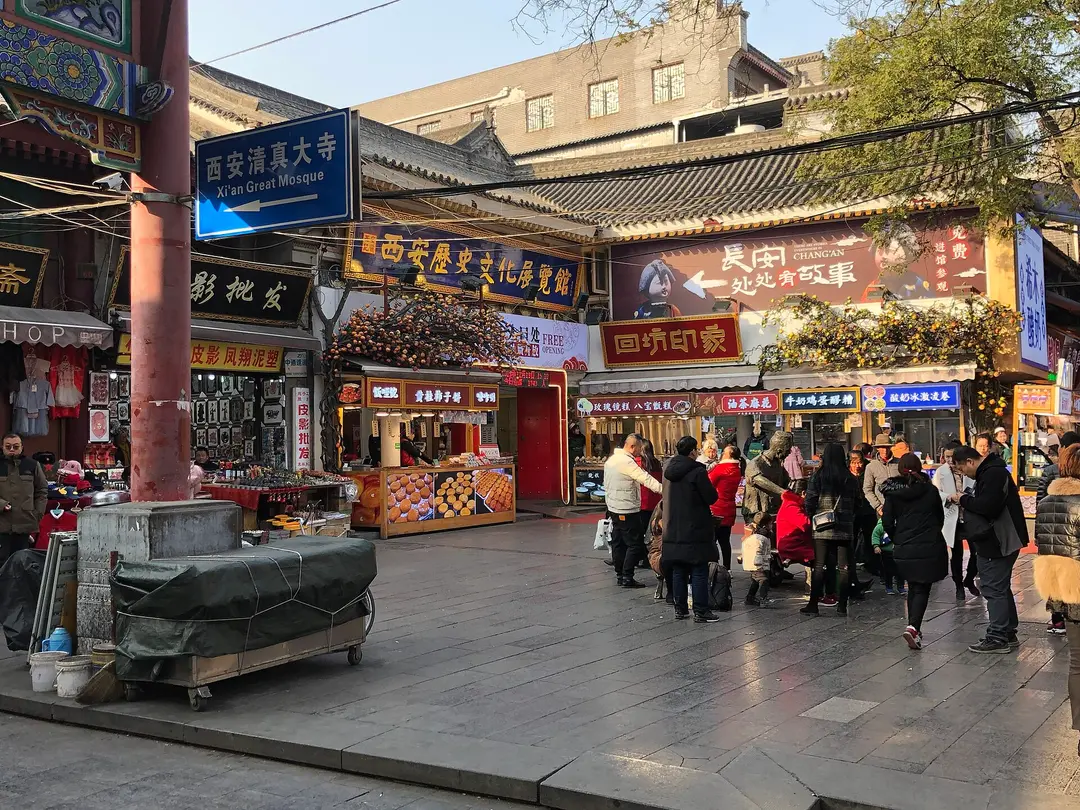
The Muslim Quarter is the old neighborhood of Xi’an’s Hui Muslim community, a few blocks of streets and lanes just northwest of the Bell Tower in central Xi’an. Visitors come for two things: the food, sold from shopfronts and stalls along every street, and the Great Mosque, a large walled mosque built in the style of a Chinese temple.
The streets are free and open at all hours. Locals live, shop and eat here, so it is a working neighborhood rather than a theme park, even on the busiest tourist strip.
The quarter sits inside the city wall, so it combines easily with the Bell Tower and Drum Tower, which stand at its southern edge. Plan on a half day here if you want to eat a proper meal, see the mosque and wander the lanes without hurrying.
The main streets
Beiyuanmen (北院门) is the main street, about 500 m long, running north from the Drum Tower. It is the busiest and most commercial part, with grill smoke, juice stands and shops selling dried fruit and nut cakes. Prices here run higher than in the side streets.
Xiyangshi (西羊市) and Dapiyuan (大皮院) are east–west lanes off the main street. They are narrower, with more long-running restaurants that serve one or two dishes, and Xiyangshi is known for lamb paomo. Huajue Lane (化觉巷) leads to the Great Mosque.
Further west again, Sajinqiao (洒金桥) is where many residents buy breakfast and snacks. It has fewer visitors and is easier to reach from Sajinqiao station on Metro Line 6. See the Xi’an food guide for what the dishes are and how to order.
The Great Mosque
The Great Mosque of Xi’an (化觉巷清真大寺), at No. 30 Huajue Lane, is still an active mosque. Its present buildings date mainly from the Ming dynasty, after 1392, on a site with older roots. It has no domes: the gateways, pavilions and a three-story octagonal tower are all in Chinese style, set in a line of courtyards with gardens and carved stone tablets. The prayer hall, with its turquoise roof, sits at the west end.
Tickets are ¥25 from March to November and ¥15 from December to February. Hours listed by guidebooks differ between about 8:00 and 9:00 for opening and 19:00 to 20:00 for closing, so go before late afternoon to be safe. Non-Muslim visitors can walk the courtyards and gardens but should stay out of the prayer hall, and parts of the site close to visitors during prayers. Cover your shoulders and knees. Allow 30–45 minutes.
A simple route
From Zhonglou (Bell Tower) station, walk west to the Drum Tower and continue onto Beiyuanmen behind it. Walk north for a few minutes, turn into Xiyangshi, then follow the signs to Huajue Lane and the mosque. Finish by eating in one of the side streets, where seats are easier to find.
When to go
The quarter is quietest from mid-morning to early afternoon. Lunch between about 11:00 and 13:00 on a weekday is a good time to eat without long waits. Evenings, especially 18:00–19:30 and weekends, are very crowded on Beiyuanmen. Public holidays, including Golden Week (October 1–7), bring the largest crowds of the year.
During Spring Festival many stalls close for several days, though sit-down restaurants mostly stay open.
Tips
- Weighed foods such as dried fruit and nut cakes are priced per jin (500 g). Confirm the price and amount before the seller cuts or bags it.
- Do not buy jade, “antiques” or souvenirs on impulse here. Some stalls run scratch-card “prize” schemes that end in a jewelry sale; walk past.
- Bring tissues; many stalls do not offer napkins.
- Portions are small at most stalls, so share dishes and try several places rather than filling up at the first one.
- Keep bags closed and phones in a front pocket on the crowded main street in the evening.
- For paying with your phone, see paying in China.
Checked on 29 October 2026. Opening times and ticket rules change; confirm on the official site before you go.